Spokane's fires destroyed more than 700 structures. The smoke is now the story for five states
Three fires that began on 1 August have burned over 10,000 acres and forced roughly 67,000 people out. No deaths have been reported. The smoke has spread far beyond the fire line, and air quality is what most of the region is now checking.
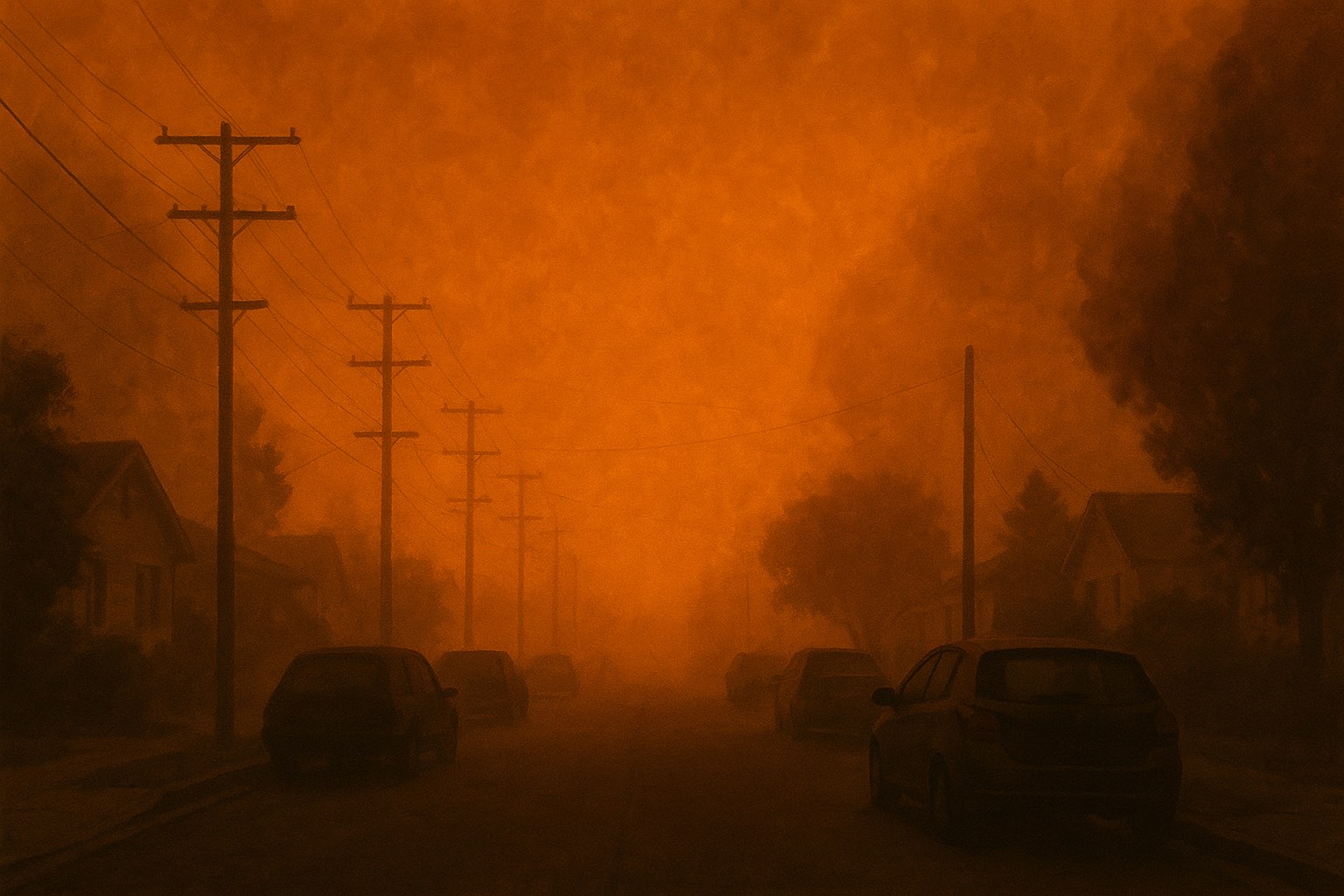
Three wildfires that started around Spokane on Saturday 1 August have become the most destructive fire event in Washington state's recorded history, and the smoke they are producing is now affecting five states and three Canadian provinces.
The fires — Old Trails, Autumn Lane and Fairview, together called the Spokane Complex — had burned more than 10,000 acres by early this week. More than 700 structures have been destroyed, around 640 of them in the Old Trails Fire alone. For scale, the 1991 firestorm that Spokane still measures these events against destroyed 114.
Roughly 67,000 people have been ordered out. Level 3 "Go Now" evacuation zones remain in place, though some zones were downgraded on 4 August as conditions eased. Containment as of 5 August stood at 13 per cent on both the Old Trails and Autumn Lane fires and 5 per cent on Fairview. Crews have shifted from cutting line to strengthening what they have, working mop-up and putting out pockets of heat near buildings still standing.
No deaths and no injuries have been reported. Fourteen people were listed as unaccounted for by the Spokane County Sheriff during the first days; all fourteen were confirmed safe. That is a genuinely better outcome than the early reporting anticipated, and it is worth stating plainly, because in a fire that moved through neighbourhoods this fast the assumption ran the other way.
The conditions that drove it were extreme and specific. Spokane International Airport recorded sustained winds of 33 miles per hour gusting to 44 on Saturday afternoon, with temperatures at 86 degrees and relative humidity between 20 and 25 per cent, as a dry cold front passed through. Those numbers describe a fire that spreads faster than people can be moved.
A 37-year-old man, Aaron Farinacci, has been arrested and charged with arson in the first degree in connection with the Old Trails Fire. A charge is an allegation. It has not been tested in court, no plea or verdict has been reported, and nothing here should be read as a finding that he started the fire.
For most of the region, though, the immediate question is not the fire line. It is the air. Smoke has reached Portland, Seattle, Boise, Salt Lake City, Vancouver and Victoria. The National Weather Service has said fine particulate matter — PM2.5, the fraction small enough to reach deep into the lungs — may reach unhealthy levels through the weekend, particularly downwind of the active fires. An air quality alert has been in effect for Spokane County since 2 August, with conditions forecast to run from unhealthy toward hazardous.
That is the practical takeaway. Air quality during a smoke event changes by the hour and by the neighbourhood, and no article can tell you what it is where you are standing. The two places that can are airnow.gov, the EPA's monitoring network, and spokanecleanair.org, the Spokane Regional Clean Air Agency's hourly readings. Health guidance during a smoke episode comes from the Spokane Regional Health District rather than from fire updates.
Acreage, containment and structure counts are all still moving. Every figure here is given with the date it was reported, and this page will be updated as the agencies revise them.
Key takeaways
See full context →Three fires since 1 August have burned over 10,000 acres, destroyed 700+ structures and displaced about 67,000 people. No deaths reported.
Containment as of 5 August: Old Trails and Autumn Lane 13 per cent, Fairview 5 per cent. All fourteen people once unaccounted for are safe.
Smoke covers five states and three Canadian provinces; PM2.5 may stay at unhealthy levels through the weekend downwind.
Source map
Explore all sources →✓What we know
- The Old Trails, Autumn Lane and Fairview fires began around Spokane on Saturday 1 August 2026 and are collectively called the Spokane Complex.
- More than 700 structures have been destroyed, about 640 of them in the Old Trails Fire.
- Roughly 67,000 people have been evacuated, with Level 3 zones still in place and some downgraded on 4 August.
- As of 5 August, Old Trails and Autumn Lane were 13 per cent contained and Fairview 5 per cent.
- No deaths or injuries have been reported, and all fourteen people previously unaccounted for were confirmed safe.
- Spokane International Airport recorded 33 mph sustained winds gusting to 44, 86 degrees and 20 to 25 per cent humidity as the fires spread on 1 August.
- Smoke is affecting five states and three Canadian provinces, including Portland, Seattle, Boise, Salt Lake City, Vancouver and Victoria.
?What remains unclear
See full context- Acreage, containment and structure counts are revised daily and the figures here carry the date they were reported.
- The cause of the Autumn Lane and Fairview fires has not been reported.
- The arson charge relating to the Old Trails Fire is an allegation that has not been tested in court; no plea or verdict has been reported.
- How long smoke will persist across the region depends on wind and fire behaviour and has not been forecast beyond the weekend.
- The full extent of damage has not been assessed, and structure counts are expected to change.
Every factual claim, and what supports it
Each statement in this article is listed with how it is classified and which of the sources below establish it. A verified fact is corroborated by two or more independent sources; a reported claim rests on fewer, or on a single party’s account.
Three fires around Spokane began on 1 August 2026 and are collectively called the Spokane Complex.
Fire names and start date consistent across independent reporting.More than 700 structures have been destroyed.
Figure reported independently by multiple outlets citing fire officials.About 640 of those structures were destroyed in the Old Trails Fire.
Per-fire breakdown attributed to fire officials.Roughly 67,000 people have been evacuated.
Latest evacuation figure as of 5 August; earlier reporting gave about 65,000.As of 5 August, Old Trails and Autumn Lane were 13 per cent contained and Fairview 5 per cent.
Containment figures dated 5 August 2026.No deaths or injuries have been reported and all fourteen people unaccounted for are safe.
Sheriff's account of the fourteen, updated after the initial reports.Spokane International Airport recorded 33 mph sustained winds gusting to 44, 86 degrees and 20-25 per cent humidity on 1 August.
Observations attributed to the airport station and the National Weather Service.The 1991 Spokane firestorm destroyed 114 structures.
Historical comparison given for scale.Aaron Farinacci, 37, has been charged with first-degree arson in connection with the Old Trails Fire.
An arrest and charge. The allegation has not been tested in court and no plea or verdict has been reported.The National Weather Service said PM2.5 may reach unhealthy levels through the weekend downwind of the fires.
Attributed to the National Weather Service.Smoke is affecting five states and three Canadian provinces.
Extent given with NOAA smoke modelling.An air quality alert has been in effect for Spokane County since 2 August.
Issued by the Spokane Regional Health District.
How the story developed
- Three fires spread around Spokane under 33 mph winds, 86-degree heat and 20-25 per cent humidity.
- An air quality alert takes effect for Spokane County; structure losses pass 600.
- All three fires reported at 0 per cent containment; smoke spreads across the Northwest.
- Aaron Farinacci, 37, is arrested and charged with first-degree arson in connection with the Old Trails Fire.
- Some evacuation zones are downgraded; all fourteen people unaccounted for are confirmed safe.
- Old Trails and Autumn Lane reach 13 per cent containment, Fairview 5 per cent.
Why this framing matters
Two things are easy to get wrong in a fire this size. The first is casualties: early coverage anticipated deaths, and the confirmed outcome — none reported, and all fourteen missing people safe — is better than the early framing and deserves to be stated rather than left as an absence. The second is the arson charge, which is an allegation against a named person and is written here as one. Beyond both, the story for most people reading is not the fire line but the smoke, which is why the air quality guidance is given with the monitoring sources rather than a number that will be stale within the hour.
8 sources reviewed
Every source used in this summary, grouped by its role in the reporting chain.
- 1Spokane Regional Health DistrictPrimary · 2026-08-02Primary
- 2Yale Climate ConnectionsIndependent · 2026-08-03Independent
- 3NBC NewsIndependent · 2026-08-03Independent
- 4KHQ SpokaneIndependent · 2026-08Independent
- 5CNNIndependent · 2026-08-03Independent
- 6Washington State Department of Social and Health ServicesPrimary · 2026-08-05Primary
- 7US Environmental Protection Agency, AirNowPrimary · 2026-08-05Primary
- 8Spokane Regional Clean Air AgencyPrimary · 2026-08-05Primary
How we verified this story
The Spokane Regional Health District and Spokane Regional Clean Air Agency pages refused automated retrieval, so air quality statements are attributed to the agencies through reporting that quotes them, and readers are pointed to the agencies' live feeds rather than given a figure that expires hourly. Every fire statistic carries the date it was reported because all of them are being revised daily; where an earlier figure has been superseded, the later one is used and the earlier appears in the timeline. The arson charge is reported as a charge, with an explicit statement that it has not been tested in court.
Updates and corrections
Preview page created.
Source context and unresolved questions updated.
Related stories and more context
 BUSINESS
AI capex in 2026: the headline totals range from $630bn to $800bn, and the gap is who gets counted
Published estimates for hyperscaler AI spending this year differ by nearly $200 billion. The disagreement is not about the companies' plans — it is about how many companies are in the set, and which baseline year the growth is measured from.
 SCIENCE
Does El Niño mean more snow? Seasonal outlooks cannot answer that, and here is why
The maps people check for a snow answer measure precipitation, which combines rain and melted snow into one number. They cannot separate the two. That is a built-in limitation of the product, not a gap someone forgot to fill.
 TECHNOLOGY
Will AI take my job? The measured effect is real, narrow, and concentrated on people under 26
The clearest evidence so far comes from payroll records, not forecasts. It shows a 16 per cent relative employment decline for 22- to 25-year-olds in the most exposed occupations — and growth where AI augments the work instead of replacing it.
Join the discussion
Help build a clearer picture. Add context, challenge a claim or share a source.