How much water do data centres use? The answer depends entirely on whether you count the power plants
Published figures differ by orders of magnitude, and almost none of the gap is disagreement about physics. It is whether the estimate stops at the cooling tower or follows the electricity back to where it was generated.
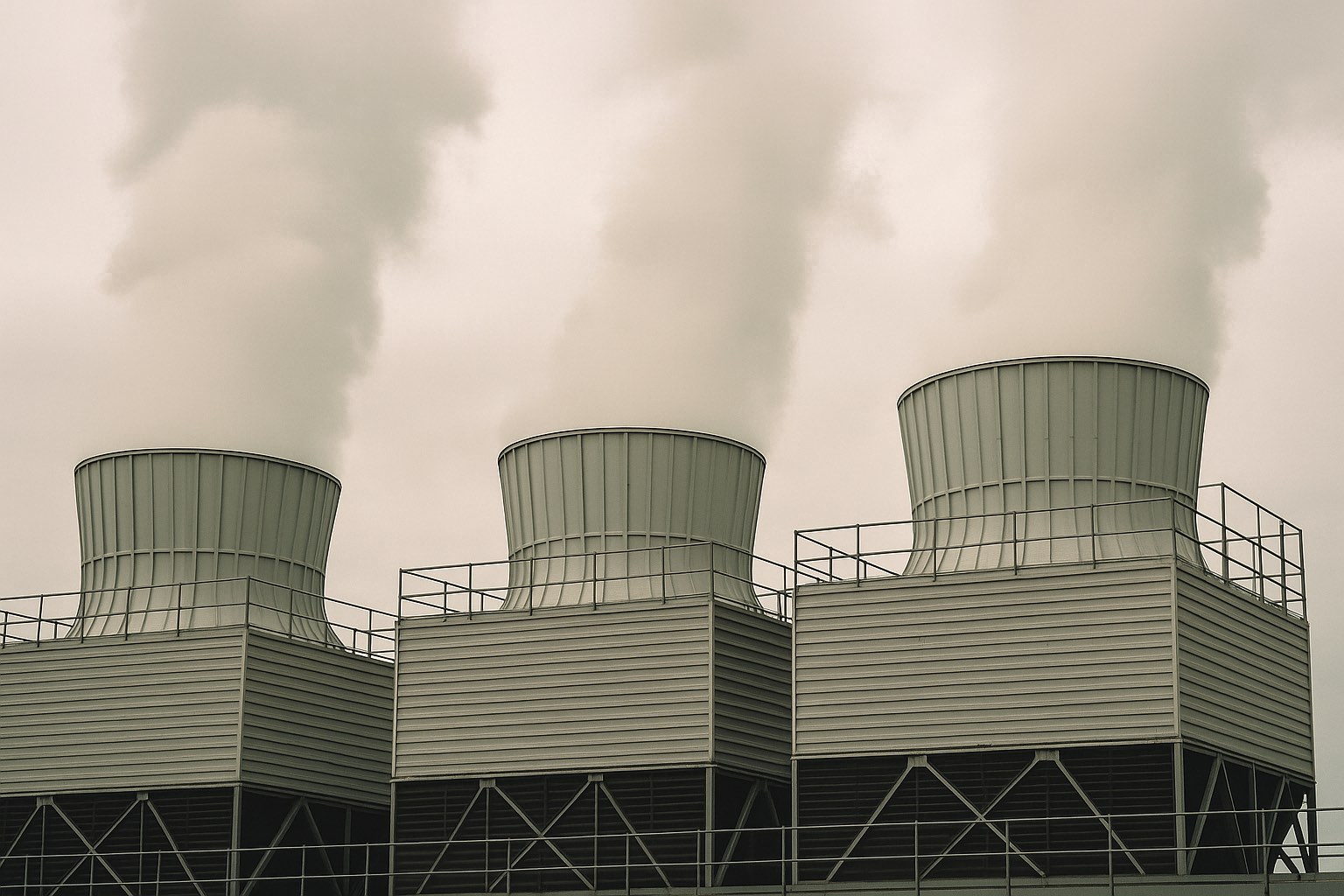
Every figure published for data centre water use answers one of two different questions, and they are almost never labelled.
**On-site cooling water** is what evaporates in the cooling towers of the building itself. **All-in water** adds the water consumed generating the electricity that building draws — thermal power plants evaporate substantial volumes, and that consumption is real even though it happens somewhere else.
The gap between those two accountings is where nearly all of the apparent disagreement lives.
Google's published measurement is a useful anchor because its scope is stated: a median Gemini text prompt consumes **0.26 millilitres** of water. That figure counts water used in Google's data centres for cooling. It excludes water consumed by the power plants supplying them.
For contrast, take the most-cited academic estimate. In 2024 The Washington Post worked with researchers at the University of California, Riverside to estimate that GPT-4 producing a 100-word email consumed **519 millilitres** — cooling water plus the water behind the electricity. That figure became "a bottle of water per email" and travelled everywhere.
Those two numbers are roughly two thousand times apart and both were produced carefully. The distance comes from three things: a 100-word email is many prompts' worth of output where 0.26 ml is a single one; one estimate is all-in and the other is cooling-only; and a 2024 model of an average US data centre is not a 2025 measurement of Google's own fleet.
There is a further wrinkle that gets left out. **Shaolei Ren, the UC Riverside researcher whose team produced the 519 ml figure, has since revised it** to roughly 15 millilitres per GPT-4 prompt, of which about 5 millilitres is on-site cooling. He describes the original as outdated for current systems. That revision is roughly thirty-five fold and has travelled nowhere near as far as the number it corrects.
Line those up with their scopes attached and they stop contradicting each other. Cooling-only, per prompt: about 0.26 ml measured by Google, about 5 ml in Ren's revised estimate for a different model on different hardware. All-in, per prompt: about 15 ml. The remaining spread is infrastructure and model, which is what you would expect.
So the per-prompt water cost of a text query is millilitres under every current estimate, including the corrected version of the one that started the argument.
That does not settle the thing actually being argued about. Per-prompt figures say nothing about aggregate withdrawal, and nothing at all about **where** the water is drawn from. A facility with a modest per-query footprint sited in a water-stressed county is a local problem regardless of how the arithmetic divides out. Whether a given datacentre strains its watershed depends on its cooling design, its location, the season and the local supply — none of which any per-prompt number addresses.
Facility-level withdrawal figures are rarely disclosed, which is why that local question usually cannot be answered from public data even when it is the only question that matters to the people asking it.
Key takeaways
See full context →Published figures differ by orders of magnitude mainly because some count only cooling water and others add the water behind the electricity.
Google measured 0.26 ml per median prompt, cooling only. The famous 519 ml figure was all-in — and its author has revised it to about 15 ml.
Per-prompt figures say nothing about where water is withdrawn, and facility-level data is rarely disclosed.
Source map
Explore all sources →✓What we know
- Published water figures split between on-site cooling only and all-in estimates that include power-generation water.
- Google reported 0.26 millilitres for a median Gemini text prompt, covering data-centre cooling only.
- A 2024 Washington Post and UC Riverside estimate put GPT-4 producing a 100-word email at 519 millilitres, all-in.
- Shaolei Ren of UC Riverside has revised that to about 15 millilitres per prompt, roughly 5 of it on-site cooling.
- Ren describes the original 519 ml figure as outdated for current systems.
?What remains unclear
See full context- Google's figure is self-reported and cannot be independently verified.
- Facility-level water withdrawal is rarely disclosed, so local impact usually cannot be checked from public data.
- Aggregate water withdrawal by AI infrastructure is not established by any per-prompt figure.
- How much the revised estimate varies by location, cooling design and season is not reported.
- Whether a given facility strains its local supply depends on conditions no per-prompt number addresses.
Every factual claim, and what supports it
Each statement in this article is listed with how it is classified and which of the sources below establish it. A verified fact is corroborated by two or more independent sources; a reported claim rests on fewer, or on a single party’s account.
Published water figures divide between on-site cooling only and all-in estimates including power-generation water.
Scope distinction stated across sources and central to the discrepancy.Google reported 0.26 millilitres for a median Gemini text prompt, covering cooling only.
Published by Google and reported independently.A 2024 estimate put GPT-4 producing a 100-word email at 519 millilitres, all-in.
Original conditions: 100-word email, average US data centre, cooling plus electricity-generation water.Shaolei Ren has revised the estimate to about 15 millilitres per prompt, roughly 5 of it on-site cooling.
Revision attributed to the original researcher.Facility-level water withdrawal is rarely disclosed.
Stated as a limit on what can be verified locally, not as a measured finding.Per-prompt figures say nothing about where water is withdrawn or whether local supply is stressed.
A siting question that per-prompt arithmetic does not address.
How the story developed
- Washington Post and UC Riverside publish the 519 ml all-in estimate for a 100-word GPT-4 email.
- Google publishes 0.26 ml per median Gemini text prompt, cooling only.
- Ren revises the per-prompt estimate to about 15 ml, roughly 5 ml of it cooling.
Why this framing matters
The numbers in this debate are usually presented as a dispute about how thirsty AI is. They are mostly a dispute about accounting boundaries, and once each figure carries its scope they largely reconcile. The article also carries the correction the original author issued, which is the single most load-bearing fact and the one least likely to have reached a reader.
5 sources reviewed
Every source used in this summary, grouped by its role in the reporting chain.
- 1Data Center DynamicsIndependent · 2025-08Independent
- 2International Energy AgencyPrimary · 2025Primary
- 3Lawrence Berkeley National LaboratoryPrimary · 2024Primary
- 4Carbon BriefIndependent · 2025Independent
- 5ForbesIndependent · 2026-07-21Independent
How we verified this story
Each figure is given with its scope, its unit and the infrastructure it describes, because stripping those conditions is what produces the apparent contradiction. Google's number is labelled as a company self-disclosure. Ren's revision is reported as the original author's own correction. No aggregate or national withdrawal figure is stated, because the per-prompt sources do not support one.
Updates and corrections
Preview page created.
Source context and unresolved questions updated.
Related stories and more context
 BUSINESS
AI capex in 2026: the headline totals range from $630bn to $800bn, and the gap is who gets counted
Published estimates for hyperscaler AI spending this year differ by nearly $200 billion. The disagreement is not about the companies' plans — it is about how many companies are in the set, and which baseline year the growth is measured from.
 SCIENCE
Does El Niño mean more snow? Seasonal outlooks cannot answer that, and here is why
The maps people check for a snow answer measure precipitation, which combines rain and melted snow into one number. They cannot separate the two. That is a built-in limitation of the product, not a gap someone forgot to fill.
 TECHNOLOGY
Will AI take my job? The measured effect is real, narrow, and concentrated on people under 26
The clearest evidence so far comes from payroll records, not forecasts. It shows a 16 per cent relative employment decline for 22- to 25-year-olds in the most exposed occupations — and growth where AI augments the work instead of replacing it.
Join the discussion
Help build a clearer picture. Add context, challenge a claim or share a source.